RESEARCH
Optical relative humidity sensor
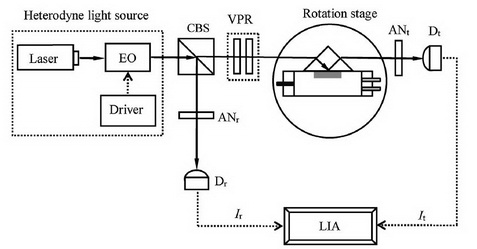
This study presents an optical relative humidity sensor based on the hydrophilic feature of a polyvinylalcohol film and a phase-enhancement total-internal-reflection heterodyne interferometer.The sensor operation is based on the interaction of a TIR evanescent wave with a polyvinylalcohol film coated onthe base of a phase-enhancement TIR apparatus. Relative humidity influences the polyvinylalcohol refractive index,thus bringing a significant variation in the phase difference between the s- and p- polarized states of abeam completely reflected from the TIR apparatus. The phase difference variation can be obtained usingheterodyne interferometric technique, and the relative humidity measurement therefore is realized. Inthis study, the sensor produced measurement sensitivity and resolution superior to 0.49。/% RH and 0.5%RH in the range of 30%–75% RH.
Optical oil slick detection
This research proposes a new type of unmanned surface vehicle, which is equipped with a set of optical oil slick detection system, which can be used to distinguish the difference between the oil slick and seawater. Its advantage is that the new type of unmanned surface vehicle can be used to detect the range of oil slick and the location is not only near but also far from the shore. Every second count in the oil spill event, the new type of unmanned surface vehicle is not restricted by day and night. Even in the rain, fog, haze, or insufficient light at night, it can still find the difference in physical properties between an oil slick and seawater. It detects the boundary between oil slick and seawater to define the range of the oil slick. It is also suitable for smallscale oil spill detection.